
Technology giant Apple has informed its customers in India that it will no longer store their card information on file and will not be accepting payments made by debit cards and credit cards for purchases or subscriptions on the App store or other Apple services. The decision has been taken by the US-based company in view of the Reserve Bank of India's (RBI's) card data storage guidelines, which will kick in from July 1. The deadline for implementing these norms was extended twice.

'Had there been no war, maybe, we would come out with a 7.5 per cent stake sale.' 'At this point in time, a 3.5 per cent stake sale looked good.'
Defying trends, the country's largest private sector lender, HDFC Bank, has shifted its asset mix significantly towards high-rated segments. As a result, its wholesale-to-retail mix has tilted heavily in favour of wholesale, even at the cost of margins. Further, it is even looking to ramp up its branch network, with an aim to service clients within a 1-2 km radius rather than the current 5-6 km radius.

Global rating agency Moody's on Monday said the high commodity prices and supply chain disruptions due to further escalation in the Russia-Ukraine crisis could expose about 42 per cent of rated Indian companies to significant risks. They are mainly in the oil and gas and automotive sectors. The impact may be seen under two scenarios: first, revised base line and second being downside economic scenarios incorporating a global recession and a more severe liquidity squeeze, it said. The military conflict between Russia and Ukraine is impacting companies in Asia Pacific, adding to existing challenges from supply chain disruption and the coronavirus pandemic.

The Indian lenders are worried over the fast depleting asset base of the Future group companies which would make their recovery of dues difficult. The asset base of Future group has eroded in the last two years due to lockdown and takeover of 947 stores by rival Reliance Retail after Future group's lease on the properties expired. Bankers said they have approached bankruptcy court so as to avoid any duplication of legal action and reduce time at the legal forums.

'The money is readily available to the depositors.'
We have not been able to communicate in a very articulate manner and clear manner on the merger as earnings were due, says HDFC CEO.

In yet another move to close the regulatory gap between banks and shadow banks, the Reserve Bank of India (RBI) has mandated exposure limits to the non-banking finance companies, in line with commercial banks. In the large exposure framework released on Tuesday, the regulator capped aggregrate exposure of NBFCs which are in the upper layer toward one entity at 20 per cent of capital base. The limit can only be extended by another 5% with board's approval. For a particular borrower group, the cap is at 25 per cent, with additional 10 per cent if exposure is towards infrastructure.
Axis Bank's acquisition of Citibank's consumer finance business for Rs 12,325 crore - the second biggest deal in the Indian banking sector - is seen as a good deal at a good price. The acquisition enables Axis Bank to close the gap with competition in some key segments such as credit cards. At the same time, there are some key issues that are crucial for the deal's success, apart from the fact that it will take some time for Axis to reap the full harvest of its investment.

The insurance regulator wants the removal of the minimum entry capital requirement of Rs 100 crore for setting up an insurance business in a bid to facilitate the entry of multiple players such as standalone micro insurers and niche players. Debasish Panda, chairman, Insurance Regulatory and Development Authority of India (Irdai), said it should be left to the regulator instead to decide what should be the entry fee for interested players, depending on the size of the business and operations. According to the current norms, insurers are required to have a minimum paid-up capital of Rs 100 crore.

'From our perspective, it will bring additional customers and from their perspective, it will get them younger customers.'

Transiting from "survival mode", which took most of the management time in FY21, the bank has been able to take a long-term view in terms of growth and preparing technology in the past 12 months.
At a time when banks are engaged in a fierce battle to gain market share in the credit card segment, Citibank India has been losing its share, both in terms of outstanding cards and spends in the last few years. Still, average spends on Citi cards are higher than any other Indian bank. Last year, the global banking behemoth announced exit from its consumer banking franchises in 13 markets across Europe, Middle East and Asia, including India, citing lack of scale.

Is the worst over for Indian banks? The past two years saw them ride on treasury trades as deposits soared and credit growth dipped sharply. Gross and net non-performing assets (NPAs) moved south, and the provision coverage ratio (PCR), capital buffers, and profitability indicators are back at pre-pandemic levels. So, what's the plot ahead?
With the banking regulator lifting restrictions on HDFC Bank's digital initiatives, the largest private sector lender is now girding up to launch a clutch of customer-facing applications (apps), which will act as stepping stones in its journey to morph into a technology (tech)-led bank from a conventional one. Following repeated outages in its digital offerings, the Reserve Bank of India (RBI) had barred HDFC Bank from issuing new credit cards in December 2020 and prevented it from going ahead with its digital launches. The embargo on issuing credit cards was lifted in August 2021 and the ban on digital launches was lifted last week.
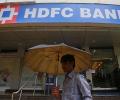
While HDFC Bank has vowed to recoup its lost market share in the credit card segment in three to four quarters by aggressively sourcing new cards, brokerages believe it is a little hard to come by, given how competitive the landscape has become, with other players in the market becoming equally aggressive to gain market share. Kotak Institutional Equities in its report on Monday said, "We would like to believe that the recovery in market share is likely to be gradual, if any. "All the key players, including Axis Bank, are now willing to expand their credit card portfolios as they have tested quite well against Covid-19."

Under the new model, the surplus distribution in the participating policyholders' fund has been modified to 90:10 in a phased manner, wherein 90 per cent will go to policyholders and 10 per cent to shareholders. Further, 100 per cent of the surplus generated out of the non-participating business will be available for distribution to all shareholders.

The country's largest lender State Bank of India (SBI) will revamp its banking application (app) YONO and position it as a complete digital bank (DB) under a new rubric 'Only YONO' for enhancing customer experience and ease of use. The bank plans to bring in a consultant to help draw up the project plan, keeping in mind business goals for the next five years. With 54 million monthly active users (MAUs), SBI YONO has seen growth of over 35 per cent in MAUs in 2021.

With the international markets facing uncertainty after Russia invaded Ukraine and Western nations retaliated with sanctions, Indian companies are putting their international fundraising plans on hold as they wait for the markets to recover. Bankers said apart from the geopolitical crisis, international rates are hardening in anticipation of interest rate hikes by the US Federal Reserve to control rising prices in the US. The Ukraine situation has implications for the market. In such a situation, international investors try to shift to safe haven assets by exiting from emerging markets.

Market regulator Securities and Exchange Board of India (Sebi) in its investigation against Indiabulls Housing Finance has found the mortgage financier non-compliant with regards to unavailability of certain information on its website as well as its internal policy. Thereby, it has directed the company to take corrective measures and inform the stock exchanges in a months' time. Several public interest litigations (PILs) and FIRs were filed against Indiabulls Housing Finance back in 2019, alleging irregularities, siphoning of funds, and other violations committed by the promoters of the company.
 © 2026 Rediff.com - Advertise with us - Disclaimer - Privacy Policy - Sitemap - Feedback - About us - Terms of use - Grievances